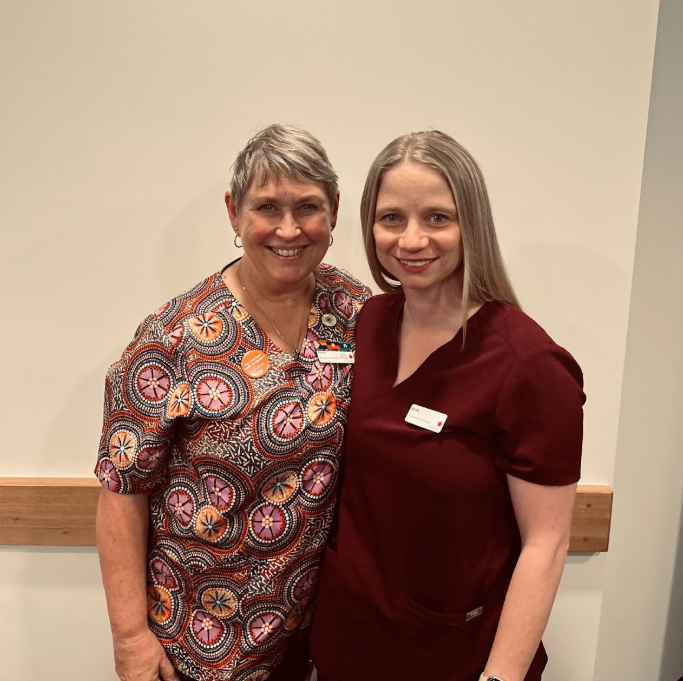
By: Kiah Leone
It has been nearly two-and-a-half years since I last sat down with Marie Jones to talk about her work with the African Women’s Clinic (AWC), and the care they provide to survivors of female genital mutilation/cutting (FGM/C) living in Australia. At the time of our previous conversation, the AWC was Australia’s only FGM/C-specific clinic, and our discussion focused on the comprehensive and specialized care they offered women navigating the long-term physical and emotional impacts of the practice. Since then, much has changed.
Marie, now a nurse practitioner, has witnessed the clinic grow in both size and demand. With new clinicians joining the team and referrals steadily increasing, the clinic has had to adapt quickly to meet the needs of the women it serves. However, what has remained constant is Marie’s commitment to improving the care of survivors by encouraging her peers in healthcare to do one simple thing: ask the question about FGM/C.
As previously noted, the AWC has experienced a significant increase in the number of referrals. So much so that the team made the decision 12 months ago to increase clinic hours in order to meet the demand.
“We found in 2024 that we were totally inundated, and it was just overwhelming”, Marie explained. “You can’t see eight women in a day. You just can’t. It’s too emotionally draining”.
When asked whether the increase reflected population growth or increases in immigration, Marie considered if it was evidence that awareness efforts within the Australian healthcare system were beginning to work – attributing the rise in referrals to clinicians becoming more comfortable in initiating conversations about FGM/C.
“Is it because we’ve slowly gotten through to people, particularly our midwives and our obstetricians, to get them to ask the question about FGM/C?” Marie contemplated.
However, it is not just simply a matter of what to ask, but also who to ask. Marie has seen firsthand how gaps in knowledge can lead to missed opportunities for care. For example, many clinicians are unaware that FGM/C is practiced in countries outside of those most commonly discussed regions, such as those in Africa.
“We’ve actually started seeing women from Indonesia,” Marie shared. “And they’re very open about it, so it’s a very different conversation because it’s Type 1 and it’s considered normal.” Type 1 FGM/C is one of four types of FGM/C that occur across the globe, with type 1 being the most widely performed. In many communities FGM/C is not something that is discussed or questioned, so it’s considered as a “normal” part of growing up for young girls.
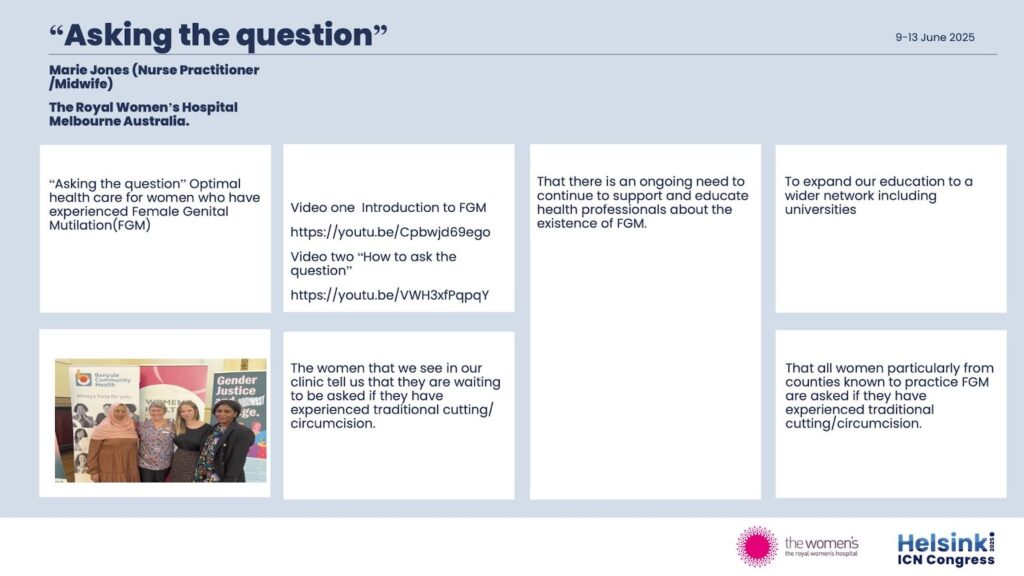
Understanding these nuances allows clinicians to approach conversations with sensitivity, cultural awareness, and accuracy, which helps to ensure that survivors receive appropriate care and support. But Marie’s efforts to ask the question extend well beyond Australia. Just this past summer she traveled to Helsinki to attend a major international nursing conference organized by the International Council of Nurses, drawing more than 7,000 nurses from around the world. It was there that Marie presented her e-poster titled “Asking the Question”, which focused on encouraging healthcare professionals to initiate conversations with patients about FGM/C.
This type of global engagement will continue in 2026 with Marie being invited to participate in an abstract for the International Midwives Conference in Lisbon, Portugal this June, alongside Juliet Albert, a Somali midwife, and a midwife from the United States, where they will share a summary of their work. The abstract is targeted towards clinicians, reinforcing the importance of shared learning across borders.
Beyond education and advocacy, the team at the AWC is playing a leading role in expanding FGM/C-specific healthcare services across Australia. For instance, Marie and colleagues are currently lending their expertise to support the development of two new clinics. Clinicians from these emerging services have spent several sessions observing the AWC in action.
“They’ve spent three or four clinics with us just seeing how we speak to the women, what language we use, what we say, what we do, what we know, and watching de-infibulations”, Marie explained.
This expansion is especially critical given the limited access to FGM/C-specific care in many parts of the country. For example, Western Australia (WA), which accounts for nearly half of Australia’s geographic size, currently has no dedicated FGM/C clinics. Therefore, it becomes common for Marie to hear stories through her colleague Christine that highlight the consequences of this gap.
“She’s got a young woman that’s been on the waiting list for five years for a de-infibulation in WA,”said Marie.
Without specialized public clinics, survivors in these regions often face the difficult choice of going without care or seeking expensive private treatment.
“That’s what the women used to do,” Marie explained. “If they had money, they would go private and have it done and pay thousands.”
As the AWC marked its 15-year anniversary this past October, Marie has begun thinking about the future of both the clinic and herself. Within the next five years, she plans to retire, but before stepping back, she hopes to conduct a comprehensive review of the clinic’s work.
“I really need to see what our numbers are, what trends we haven’t noticed because we haven’t had time to notice,” Marie shared. “Put all these stats together so we actually know what we’re looking at.”
Another priority moving forward is rebuilding community engagement. Like many services, the clinic’s outreach efforts were disrupted by the pandemic.
“We haven’t had the community engagement that we used to have pre-pandemic”, Marie explained. “We don’t know what’s going on in the community either.”
Before COVID-19, the clinic regularly hosted school groups, offering sexual and reproductive health education in areas where students came from countries that practice FGM/C. Marie hopes to re-establish these connections over the next year in order to strengthen trust and dialogue with FGM/C-affected communities.
For Marie, as we move into 2026, the work is far from over. Whether she is supporting survivors in clinics, mentoring clinicians, or speaking overseas, her impact continues to be felt – both in Australia and beyond. I look forward to reconnecting with Marie once again upon her return from her next international journey as she continues to share her knowledge, raise awareness, and encourage peers to ask the question!
To learn more about asking the question, check out the AWC’s video for health professionals here.