By Kaitlyn Sze Tu, Sahiyo Editorial Intern
Female genital cutting (FGC) is a harmful practice that impacts women across the globe, regardless of location. For anti-FGC activist Saza Faradilla – co-founder of End FGC Singapore and a Voices to End FGM/C alum – her home city of Singapore is no exception.
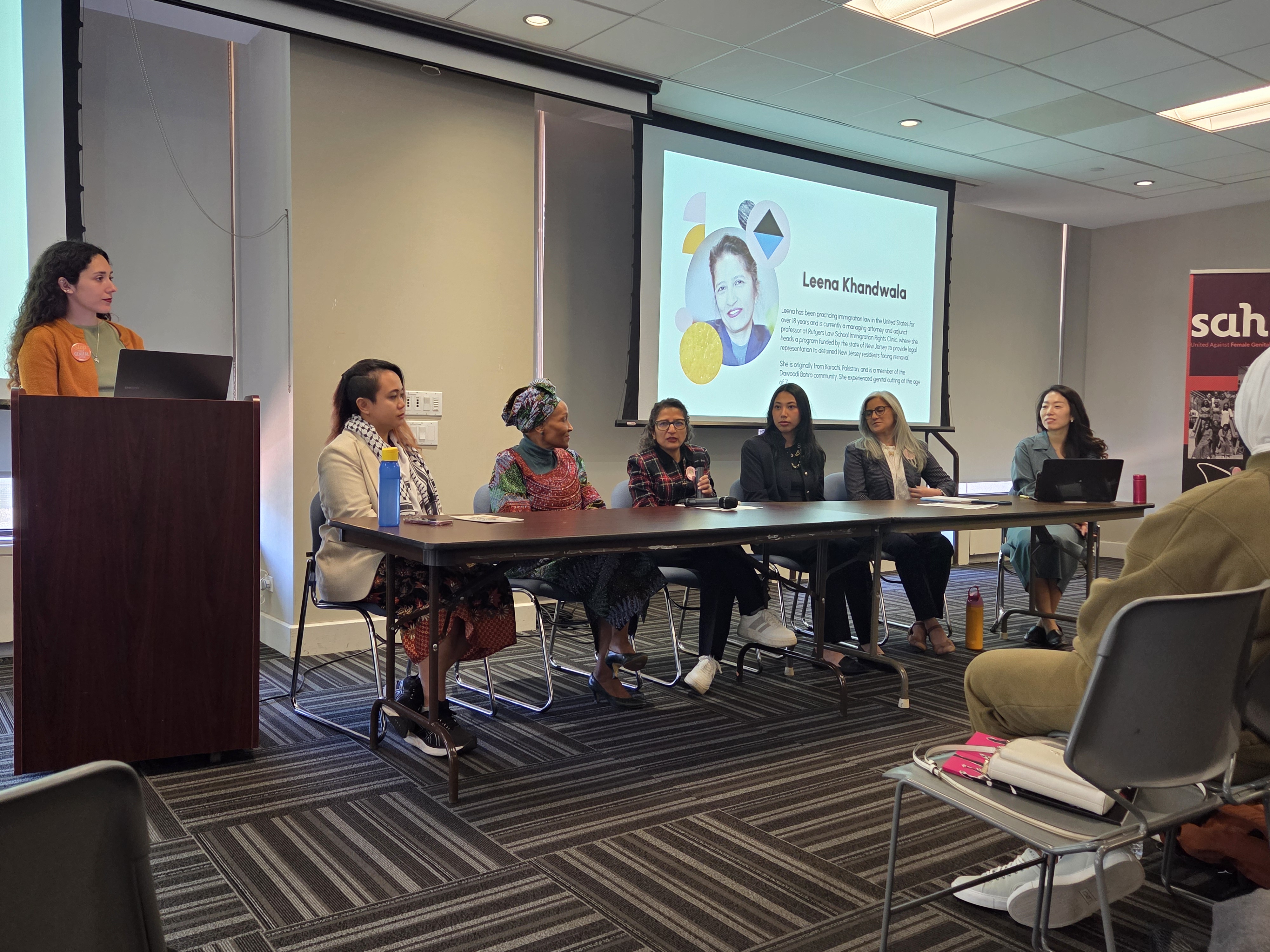
Sahiyo Editorial Coordinator Sheena Vasani recently sat down with Saza to talk about her journey as an activist and her experience speaking at Sahiyo’s powerful parallel event, “Storytelling as a Tool for FGM/C Survivor-Centered Change,” held during the 69th session of the Commission on the Status of Women (CSW) at the United Nations.
“What was most impactful was hearing from my fellow panelists,” Saza says. “There were two from the Bohra community, and one of them spoke about how she remembered her cutting because it was done when she was six or seven years old. It was incredibly brave. A lot of people teared up hearing how she was tricked into being cut.”
Though Saza doesn’t remember her own experience — she was cut as a baby — the discovery at age 20 was life-changing.
“I found out accidentally when I was 20 years old, and I was very upset about it. I wrote all my college papers and my thesis on it. I found other survivors and activists, and that was how we started the movement in Singapore,” she said.
She later co-founded End FGC Singapore, a community effort advocating for the end of female genital cutting, and launched a pilot study. “We found 75% prevalence [of FGC in Singapore],” she says. “And it’s probably higher. That became the impetus for a movement.”
Saza’s activism eventually led her to collaborate with Sahiyo in 2018, when she shared her story in Malay as part of the Voices to End FGMC storytelling project.
“It was an intentional decision to tell the story in Malay, which is my mother tongue,” she says. “FGM is practiced mainly by the Malay community in Singapore, and I wanted to speak directly to that community. If it were told in English, there would be an assumption of Western hegemony.”
That drive to amplify diverse voices was central to Saza’s experience at CSW69. Speaking at Sahiyo’s CSW event, she saw it as a powerful opportunity to underscore how essential diverse perspectives are to meaningfully addressing FGC.
“People are always shocked when they hear it happens in Asia—even though 80 million girls and women in Asia alone have been affected,” she said. “Bringing awareness to that fight has a ripple effect in diasporic Asian communities too.”
Saza also appreciated that the panel created space to address deeper, often overlooked issues — such as the subtle racism embedded in global FGC discourse.
“In Singapore, people often say, ‘What happens here isn’t FGM—that happens in Africa.’ But that carries a racist undertone. It’s like saying, ‘We’re not like those people—those Black people—who don’t know any better.’ That’s something we need to reflect on within our movement in Asia.”
Understanding regional differences, she emphasized, is essential to effective advocacy.
“Western-centric narratives often overshadow those from the Global South—even at spaces like CSW. “FGC in Asia isn’t the same as FGC in Africa or the Middle East. We need to ask whether our strategies are actually working for our communities.”
She recalled a conversation with a UNICEF representative who shared a study on monitoring and evaluation of various anti-FGC strategies globally: “I asked her, ‘So, what works in Asia?’ And she said, ‘Honestly, we don’t know—there’s no research.’ That really stuck with me. Advocacy here is still so nascent.”
Saza says she was also pleased to see that the panel’s diversity went beyond geography.
“It was great to have people from Asia, Africa, the U.S., and also more diverse sexual and gender orientations,” she adds. “There isn’t enough conversation about FGM happening to gender-diverse individuals. I feel like that’s partly why the FGM movement in the U.S. has been co-opted by the anti-trans movement—to discriminate against the LGBTQ+ community.”
Even more excitingly, the powerful conversations at CSW69 may have set some real change in motion. During another panel hosted by the Global Platform for Action to End FGM, Saza spoke openly about her often-criticised stance against criminalization. Criminalization, she explained, can unintentionally drive the practice further into secrecy and deter survivors from seeking support out of fear that their families or communities might face legal consequences.
Instead of punitive measures, Saza emphasized the importance of community education, culturally sensitive engagement, and survivor-centered care.
“The US has banned it, the UK has banned it, Australia has banned it, but it still continues underground. If we ban it in Singapore, people will bring their babies to Malaysia, or Brunei where the cutting is worse. We don’t want to use the penal justice system on already marginalized communities such as the Muslim community in Singapore,” she explained.
To her surprise, a government representative who had attended the panel approached her afterwards.
“She said, ‘That was great. Let’s see what we can do.’ The Singapore government rarely wants to work with civil society. But now I have meetings lined up with her. That was huge.”