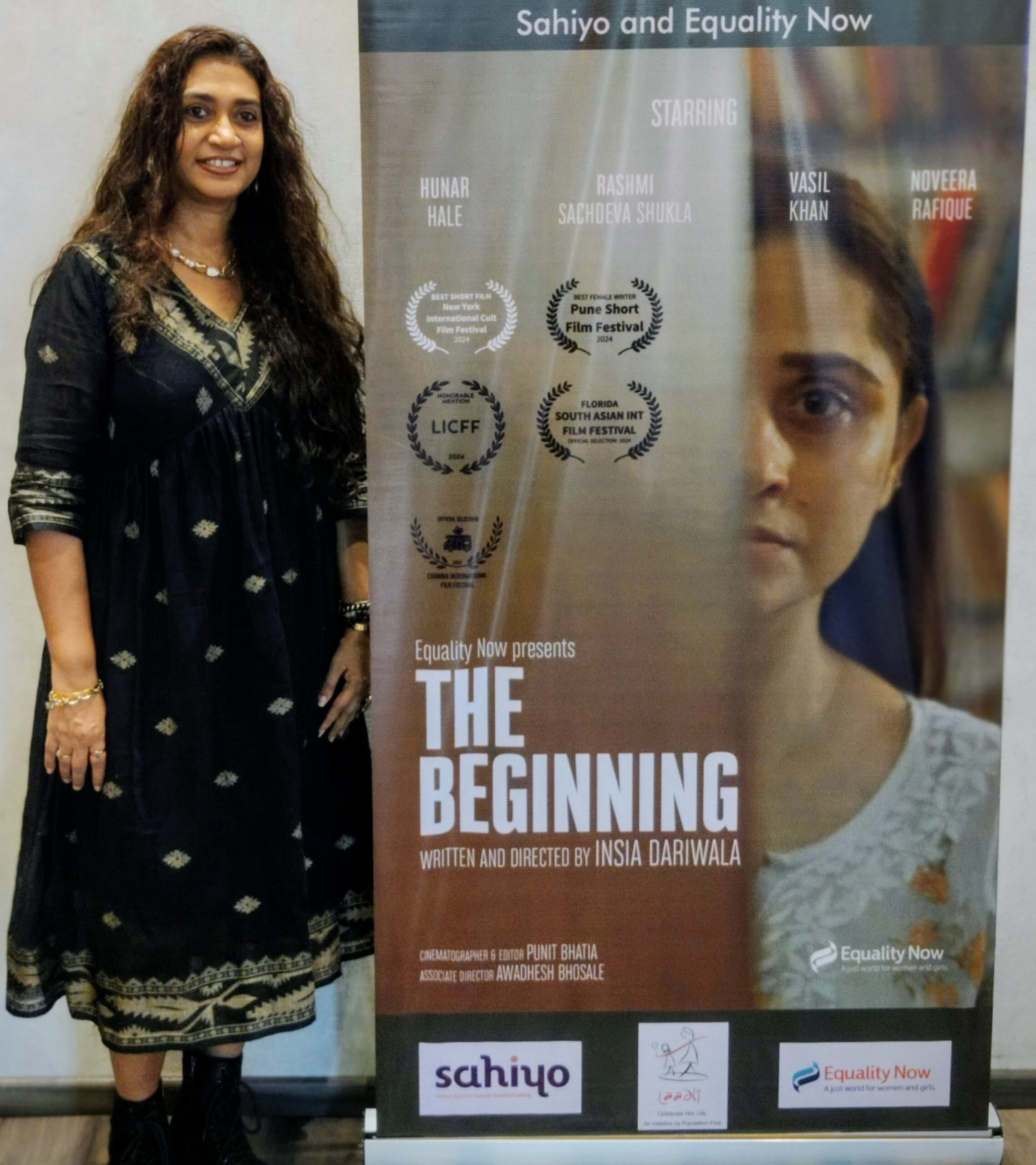
About the Founder: Insia Dariwala is an award-winning international filmmaker/child rights activist, TEDx speaker, an Author, a Therapist, and a Creative Campaign Strategist who effectively uses her creative expertise to highlight various social evils, including, child sexual abuse (CSA), and female genital cutting (FGC) through the medium of visual arts and cinema.
- How did you all come together as five co-founders and start Sahiyo?
I was writing a film on FGM at the time, and while doing research on the topic, I came across Aarefa and Priya. Since Aarefa lives in Mumbai, we met up, and there was an instant connection and trust. It’s unexplainable. I believe what brought us together was a common thread of pain and trauma. I’m not cut, but all the girls in my family are. My film’s story explores that generational trauma, and I feel very happy that it, (The Beginning), was finally produced by Equality Now.
Meeting people is very easy, but to connect and persevere with a common goal is rare. I feel blessed that we found that in each other and it is this sisterhood that kept us glued together and saw us through a very exciting and sometimes difficult, 10 years.
- What were your initial goals or hopes for Sahiyo, and how has your vision evolved since its founding?
For me the goal was very clear, we needed more women to share their stories about FGM, and I was confident that through our flagship program, Thaal Pe Charcha (TPC) we could give survivors the space to share their collective pain, while relishing a traditional Bohra meal. The success of TPC led me to a deeper understanding that storytelling is indeed a very powerful tool to build communities, and so we made storytelling the central point for most of our programs/activities.
- What moments over the past 10 years are you the most proud of?
Having been invisible for such a long time in context to the issue of FGM in Asia, I felt very proud to see Sahiyo spotlighted at the Global Summit for FGM in Washington D.C. It finally felt like we mattered and that our pain also mattered.
Another proud moment for me was the success of the first Thaal Pe Charcha (TPC) event. When I came up with that concept, I had no idea it was going to be so successful. But at one of the TPC events, It was heartening to hear one of the survivors say-“I wish Sahiyo was there before I cut my daughters. I would not have cut my daughters had I known the reality of this practice earlier.”
Today TPC has gone global and we train others to conduct this event in their cities and countries around the world.
- As you reflect on the last decade, what are some of the most valuable lessons and insights you’ve gained?
Never underestimate the power of one person, and never underestimate the power of community engagement. While it requires one person to take that small step, it also requires an openness from the people to help us move forward.
I would say the secret to our success has been the three C’s- Collaborations, Communication, and Compassion.
- What does it mean to you that Sahiyo is celebrating its 10 year anniversary?
When I look back, I really admire how despite all odds, a group of five women from entirely different worlds united by one mission, sparked a fire so bright that the world had no choice but to look up and pay attention. It’s so fulfilling!
On a personal note-as a Spiritual Practitioner, I am a strong believer of intention and alignment of mutual energies. Sahiyo is living proof of how when the intentions are pure, and the energies collectively align, anything is possible. Anything!
- In what ways have you seen the anti-FGC and gender based violence activism space change and evolve over the past 10 years?
With the burst of activism in digital spaces, and a global support against this practice, women are becoming more vocal about speaking up and sharing their stories of pain. Thanks to our innovative programs, storytelling became a common tool for many organizations to replicate in their own initiatives. Storytelling is a powerful tool and it’s important to remember that behind every statistic, there are human experiences that we shouldn’t forget.
I remember, when we started our journey, we were the only ones talking about FGM in India, but slowly many more collectives around Asia joined in and the Asia network to End FGM/C was formed.
Believe it or not, we have more than 230 million girls who have been cut worldwide and out of that, 80 million are from Asia.
Additionally, we have formed strong partnerships with organizations such as The Wallace Global Fund, Orchid Project, Equality Now, and Global Health Strategies. Our global partnerships have been instrumental in pushing the movement to end FGM Forward. I am positive we will continue building partnerships to receive the vital resources needed to end FGM.
- How does Sahiyo fill a gap in the global movement to end FGC?
Like I mentioned earlier, the discourse on FGM within the Asian context was totally missing. I believe our work at Sahiyo bridged that gap, and paved the way for many other Asian organizations to combine their forces against this harmful practice.
- How would you like to see change and grow over the next 10 years?
Growth is lifelong and while I don’t know where we will be in 10 years, I do have a desire to see Sahiyo become an organization where we are not just rallying to end FGM but also, providing the mental well being support that many survivors of FGM need.
Apart from my creative expertise and advocacy work, today I am also very focused on bringing in the element of healing to our survivor community. As a Therapist, I have witnessed the pain and generational trauma that survivors battle, and it’s important we acknowledge that suffering and provide that healing so that survivors get the opportunity to live a fuller life, despite what they went through.
Another desire I harbor is to create many more leaders like us who can carry the torch forward, long after we have gone.