By: Catherine Cox
The last time I was in Oxford was in December, and the fog hung so low across the city that you could barely see two feet in front of you.
I was back now, in July this time, and finally able to really see the beauty of the city during one of its rare sunny days. It was hard not to be swept up in the charm of cobblestoned streets and buildings named after people I had read about in history class.
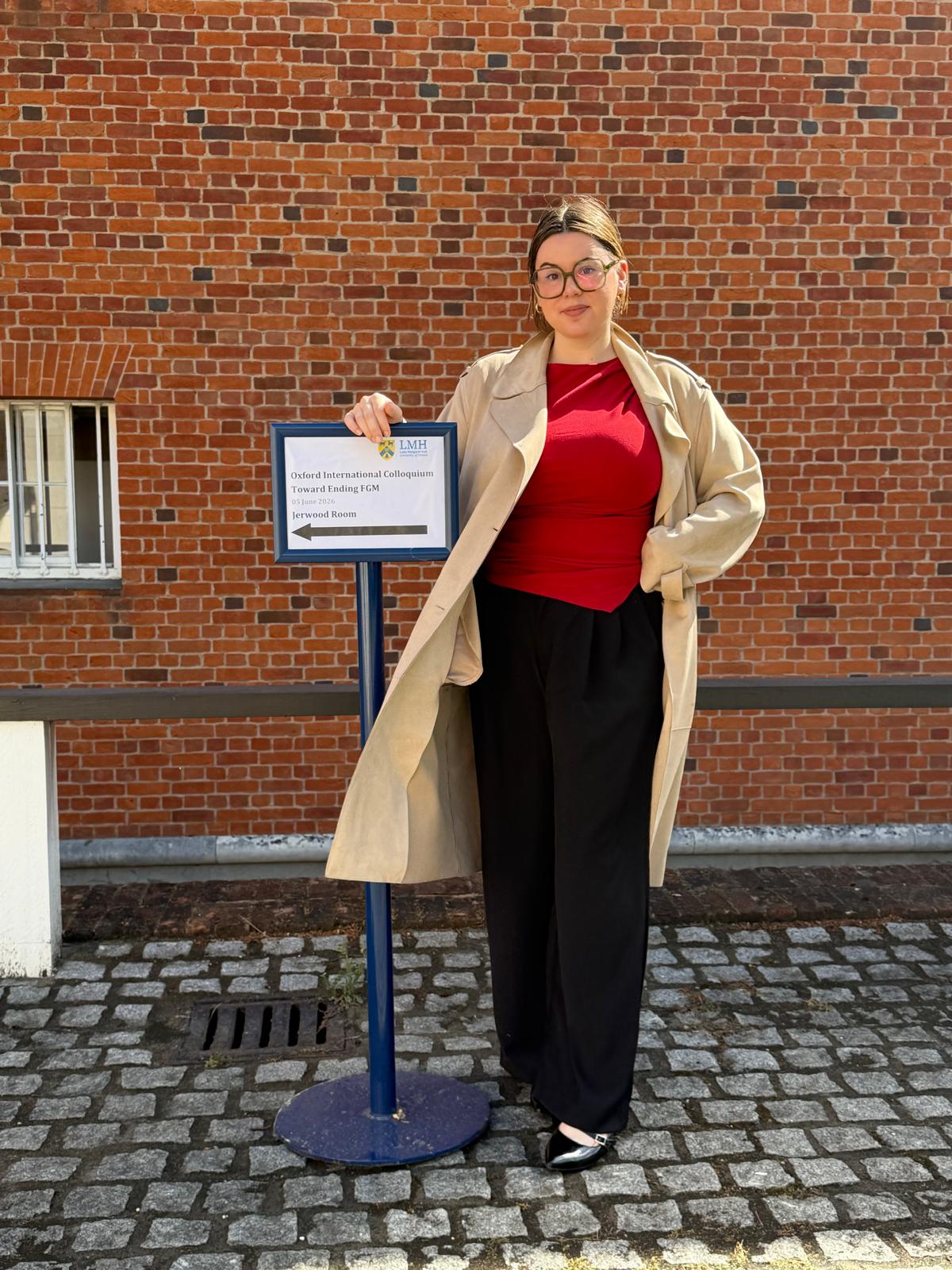
I had been invited back on behalf of Sahiyo to attend the biannual Oxford International Colloquium Toward Ending FGM,. The aim of this conference was to promote education and awareness around FGM/C and to encourage exchange among academics, physicians, and frontline campaigners.
I felt incredibly privileged to be able to walk the corridors of Lady Margaret Hall, which were lined with photos of Oxford University alumni, and to sit in a room with activists who had been working on the issue for decades – some longer than I had been alive.
During the conference, I got to hear from people championing change around the world. I was also privileged to share about Sahiyo’s work to empower communities and uplift survivors’ voices. While hope was palpable, so too was the ever-increasing list of challenges facing campaigners; including racism, climate change, and the global retrenchment of women’s rights.
Throughout the conference, one theme was shared broadly by attendees from across different fields (and countries) – funding for FGM/C prevention is drying up.
Across the sector, funding is becoming harder and harder to come by. Driven by economic challenges and changing political landscapes, obtaining funding for crucial support services for FGM/C survivors and prevention initiatives has become increasingly difficult. One possible solution: mainstreaming FGM/C within the larger Genber-Based Violance/Violance Against Women and Girls (GBV/VAWG) sector.
I first joined Sahiyo in 2020 as a bright-faced 19-year-old and the second-ever post-holder for the Program Intern role. Over the course of three years, I became the U.S. Programme Coordinator, responsible for helping to organize in-person and online events across the United States – and globally. It was with Sahiyo that I first had the opportunity to speak at places such as the UN Commission on the Status of Women (CSW) parallel events, help organize sessions with Women Deliver in Rwanda, and many others.
It has been six years since then, and I am proud to say that my commitment to ending FGM/C and empowering communities has remained the same.
While I no longer work in FGM/C prevention directly, my work with Sahiyo played a major role in my decision to continue working within the VAWG/GBV sector. I currently work as a Community Prevention Officer, helping to empower communities to end all forms of VAWG/GBV – including FGM/C. It has been an important part of my day-to-day work to ensure that FGM/C is incorporated into mainstream VAWG/GBV services and not siloed as an issue peripheral to VAWG/GBV, but recognized as part of the lifetime spiral of gender violence.
Part of my belief in the power and importance of mainstreaming FGM/C comes from helping to implement Sahiyo’s project with the Asian Women’s Shelter (AWS).
In January 2022, Sahiyo began working with AWS, a domestic violence organization, on a three-year project funded by the Department of Justice’s Office for Victims of Crime. The goal of this project was to increase the capacity of care for survivors of FGM/C in the United States. For eight months, I helped facilitate a series of in-depth, interactive trainings for AWS staff, volunteers, and crisis line volunteers on FGM/C and how best to support survivors. As a result, Asian Women’s Shelter was able to expand the capacity of its crisis line to include support for survivors of FGM/C.
During this project, I was able to witness firsthand how incorporating FGM/C within so-called “mainstream” VAWG/GBV services helped to create more pathways to support for survivors and helped increase mainstream organizations’ capacity to respond to their needs.
One concern that came up in our work was the worry that FGM/C might get “diluted” within larger organizations. That concern is not without merit. It is important that organizations like Sahiyo, which are solely dedicated to the mission of ending FGM/C, continue to exist and have the specific knowledge and programmes needed to support survivors. These organizations ensure that survivors have the kind of support that addresses their unique experiences as survivors of FGM/C and can conduct tailored research and outreach within impacted communities.
The goal of mainstreaming FGM/C, therefore, should not be to replace these crucial services but to help shore up the gaps in support that exist for survivors and to ensure that survivors can access support even when there are funding challenges.
My work both within the FGM/C prevention space and in the larger VAWG/GBV sector has shown me that, in order to successfully integrate FGM/C into larger services, training is essential. However, this cannot be a one-off intervention. Programmes like Sahiyo’s multi-year training partnership with AWS are crucial to ensuring that organizations not only understand who may be vulnerable to FGM/C, but also how to support survivors and gather ongoing feedback on the implementation of their services.
It is also important that service delivery be reshaped around the needs of survivors of FGM/C, rather than merely adding FGM/C ‘and stirring’. This could include reviewing intake and risk assessment procedures to make sure the capture information on FGM/C, developing referral pathways to specialist organizations, and ensuring that staff feel confident having conversations about FGM/C in a culturally safe and trauma-informed way. Mainstreaming FGM/C also requires meaningful partnerships between specialist FGM/C organizations and mainstream VAWG/GBV services.
While it will take effort, I believe that mainstreaming FGM/C has the possibility of shoring up funding shortages, providing a greater network of support options for survivors – and could actually help to rase the profile of by-and-for organizations by sharing funding with larger entities.