By: Khushi Prakash
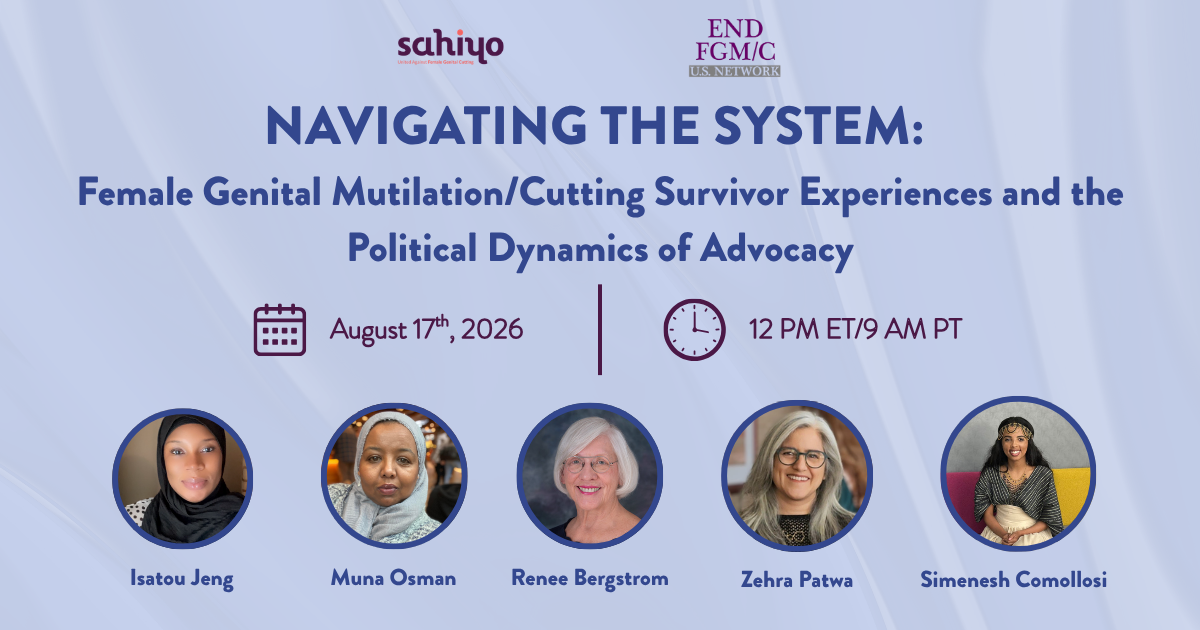
Date: Monday, August 17th, 2026
Time: 12 PM ET/9 AM PT
Registration: https://bit.ly/NavigatingtheSystem
Description:
This webinar is officially releasing and sharing key findings from Sahiyo’s new listening session report, Navigating the System: FGM/C Survivor Experiences and the Political Dynamics of Advocacy. The report summarizes insights from a listening session during which survivors of female genital mutilation/cutting, (FGM/C), who have engaged in, or explored, policy advocacy in the United States.
The report highlights the emotional, structural, and political dynamics that shape survivor participation in policy spaces, including public testimony, legislative meetings, coalition advocacy, and broader efforts.
The webinar will feature a discussion among survivors of FGM/C, Isatou Jeng, Muna Osman, Zehra Patwa, Renee Bergstrom, and Simenesh Comollosi, all of whom have played key roles in policy advocacy. The speakers will reflect on their experiences navigating policy spaces and explore how policymakers, advocates, and organizations can make these processes more trauma-informed, survivor-centered, transparent, and accessible.
The webinar will also introduce the new Policy Advocacy Care Fund, a new initiative by The US Network to End FGM/C and Sahiyo and share information about the fund’s purpose and role in supporting participation in policy advocacy.
Why Policy Engagement Matters
Policy engagement is essential to create lasting protections for survivors and women and girls at risk for FGM/C. It is also a crucial step in expanding access to healthcare and survivor services, and supporting prevention and community education. Effective policies must reflect the needs and lived experiences of the individuals that they intend to support. When survivors are not involved in the policy development conversation, laws and programs might miss barriers and reinforce harmful assumptions.
Why Survivor Policy Engagement is Essential
Survivor engagement is not merely a component of advocacy; it is the cornerstone of sustainable policy reform. When survivors are at the center of policy development, they transform abstract legislative goals into clear, human-centered solutions. Their involvement ensures that laws—whether criminal penalties or civil liabilities—are grounded in the realities of survivors’ long-term health and emotional well-being. By partnering with impacted communities, we shift the power dynamic: moving from a system that asks survivors to perform their trauma, to one that actively listens, learns, and builds policy in partnership with the experts of lived experience.
Why This Report Matters
Although survivors are often asked to participate in advocacy, less attention is given to what that participation requires of them. Policy engagement can involve repeatedly sharing traumatic experiences, responding to invasive or insensitive questions, navigating unfamiliar legislative systems, and managing expectations that one survivor can speak for an entire community.
The Navigating the System report brings these often-unspoken experiences to the forefront. It examines the “hidden curriculum” of policy advocacy—the emotional, structural, and political expectations that survivors must learn to navigate in order to participate.
The report’s release during the webinar will provide attendees with an opportunity to hear its findings directly from those involved and consider how its recommendations can be applied within their own advocacy, policy, research, or community-based work.
Why You Should Attend
This webinar is an opportunity to hear directly from survivors who have navigated policy advocacy, access findings from the newly released Navigating the System report, and learn about efforts to make survivor participation safer, more accessible and sustainable.
The webinar is intended for survivors, advocates, policymakers, community organizations, funders, and anyone interested in strengthening survivor-centered advocacy.
Join Sahiyo and The U.S. Network to End FGM/C on August 17 for the release of Navigating the System, a discussion with survivor advocates, and the introduction of the Policy Advocacy Care Fund.
Register here: https://bit.ly/NavigatingtheSystem
Webinar Recording:
Listening Session Report: https://bit.ly/SahiyoListeningReport