By Lubaina Plumber
The Massachusetts Women of Color Network held its 9th Annual Conference on May 14 and 15 at Springfield College. I attended as a panelist on behalf of Sahiyo. The theme this year, Survival Is a Group Project, drew its framing from the tradition of mutual aid and collective care, and the program was built to reflect that. It brought together advocates, practitioners, and community members working at the intersection of gender-based violence, racial justice, and community wellbeing.
What stayed with me from the conference was not any single session in isolation, but the cumulative sense of a community that has been doing this work for a long time and has found ways to sustain itself in the process.
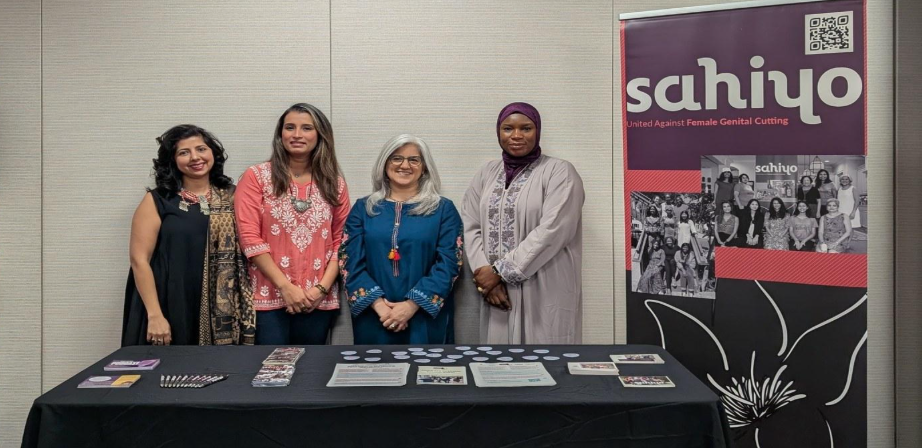
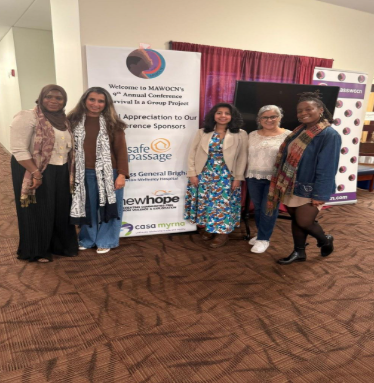
Sahiyo team across both days.
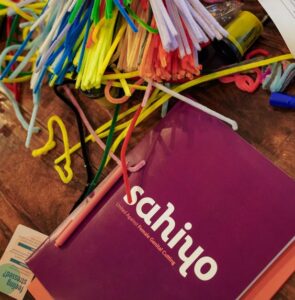
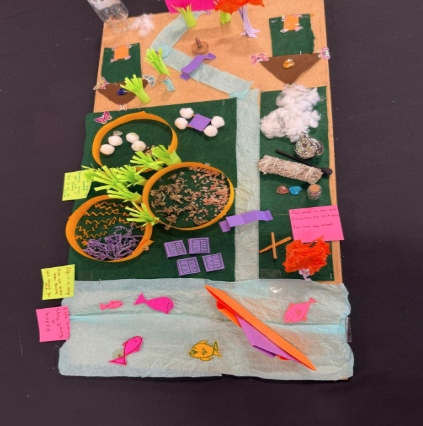
One of the more considerate touches of the conference was a collective art installation, in which the attendees built a shared neighborhood from craft materials over the course of both days. Each contribution was intended to represent something the participant was bringing to the collective. It was a simple idea that worked well, and by the close of the conference, the installations had become a genuinely layered, communal object. It said something about the organizing philosophy behind the event that words alone would have struggled to convey.
ON COLLECTIVE SURVIVAL
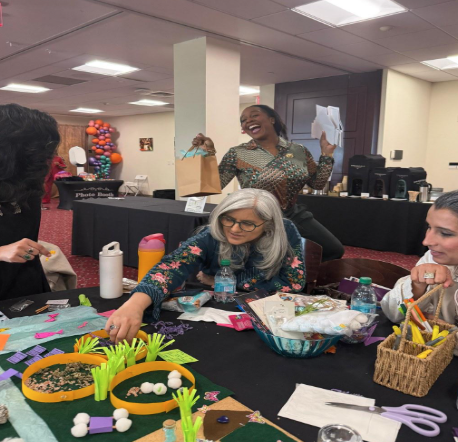
Kishana Osei, Executive Director of MAWOCN, opened the conference and introduced the neighborhood installation before welcoming keynote speaker Andrea M. Garr-Barnes. The evening breakout sessions followed, and I chose Kiki Ghossainy’s self-defense training with IMPACT Boston over the joy and creativity session running in parallel.
There is something quietly clarifying about a room full of women learning to physically defend themselves. Not the idea of it, the actual practice of it. It was one of the more unexpectedly affecting parts of the conference. Kiki and her co-facilitator created an environment that was both rigorous and warm, and the conversation that continued informally afterwards felt like a natural extension of everything the conference had been building towards.
REPRESENTING SAHIYO
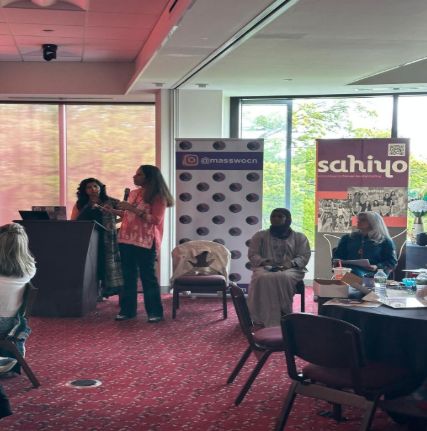
On Friday morning, I was part of the panel Stories That Sustain Us: Collective Care, Storytelling, and Ending FGM/C, alongside panelists Zehra Patwa, Isatou Jeng, and Naqiya Hussain. We spoke about the Voices to Action project and the relationship between survivor storytelling and systemic change. Speaking to an audience of people of color advocates meant that certain things did not require extensive contextualization. There was a shared understanding of how structural harm operates and what it takes to address it, and that made for a more substantive conversation.
FROM PET TO THREAT
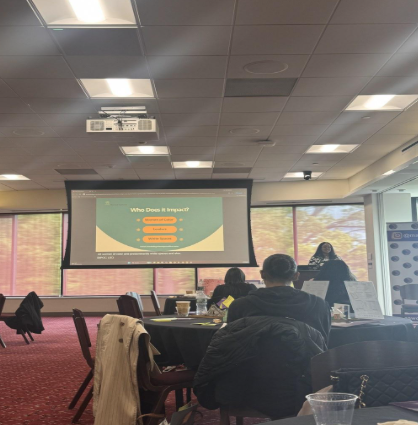
From Pet to Threat.
The session that generated the most reflection for me was Brandie Stringer’s, From Pet to Threat. The session examined a well-documented phenomenon in which women of color who are initially welcomed in professional and organizational spaces find themselves, over time and with increasing seniority, treated with suspicion or outright hostility. The session gave participants language for experiences that are common but rarely named precisely. That kind of naming has practical value. It is harder to challenge something you cannot yet articulate.
CLOSING REFLECTIONS
The conference closed with the Leadership & Legacy Award, presented to Carmen Nieves, Executive Director of Alianza, formerly known as Womanshelter. It was a fitting conclusion to a gathering that was, at its core, about honoring the people who do sustained, unglamorous work in communities over long periods of time.
For Sahiyo, being present at this conference was a reminder that our work does not exist in isolation. The conversations happening in spaces like this one, about race, safety, collective care, and institutional harm, are the same conversations we are navigating. Showing up matters.