By Huda Syyed, PhD
Welcome to Women Deliver 2026
Working across both academia and advocacy spaces with years of experience researching gender, violence, culture and bodily autonomy, I came to Women Deliver 2026 (WD2026) to learn, to unlearn, and to advocate. Powerful moments happened at the conference, but what stayed with me the most were the honest conversations about power, visibility and labour, and especially the ways Brown and Black women and survivors so often carry movements through emotional, intellectual, and organising work that remains overlooked.
WD 2026 was held in Melbourne (Naarm), Australia, and brought together activists, survivors, researchers, policymakers, grassroots organisations and leaders from across the world to discuss issues including bodily autonomy, sexual and reproductive health and rights, gender-based violence, Indigenous rights, climate justice, refugee issues, and movement-building. Along with formal panels and concurrent sessions, WD2026 created space for difficult but necessary conversations about power, hierarchy, and tokenism. It was a space where the voices that are not always amplified in systems and governments around the globe were heard.
The Concurrent Session: Dismantling Racism in Anti-FGM/C Movements & Decoloniality
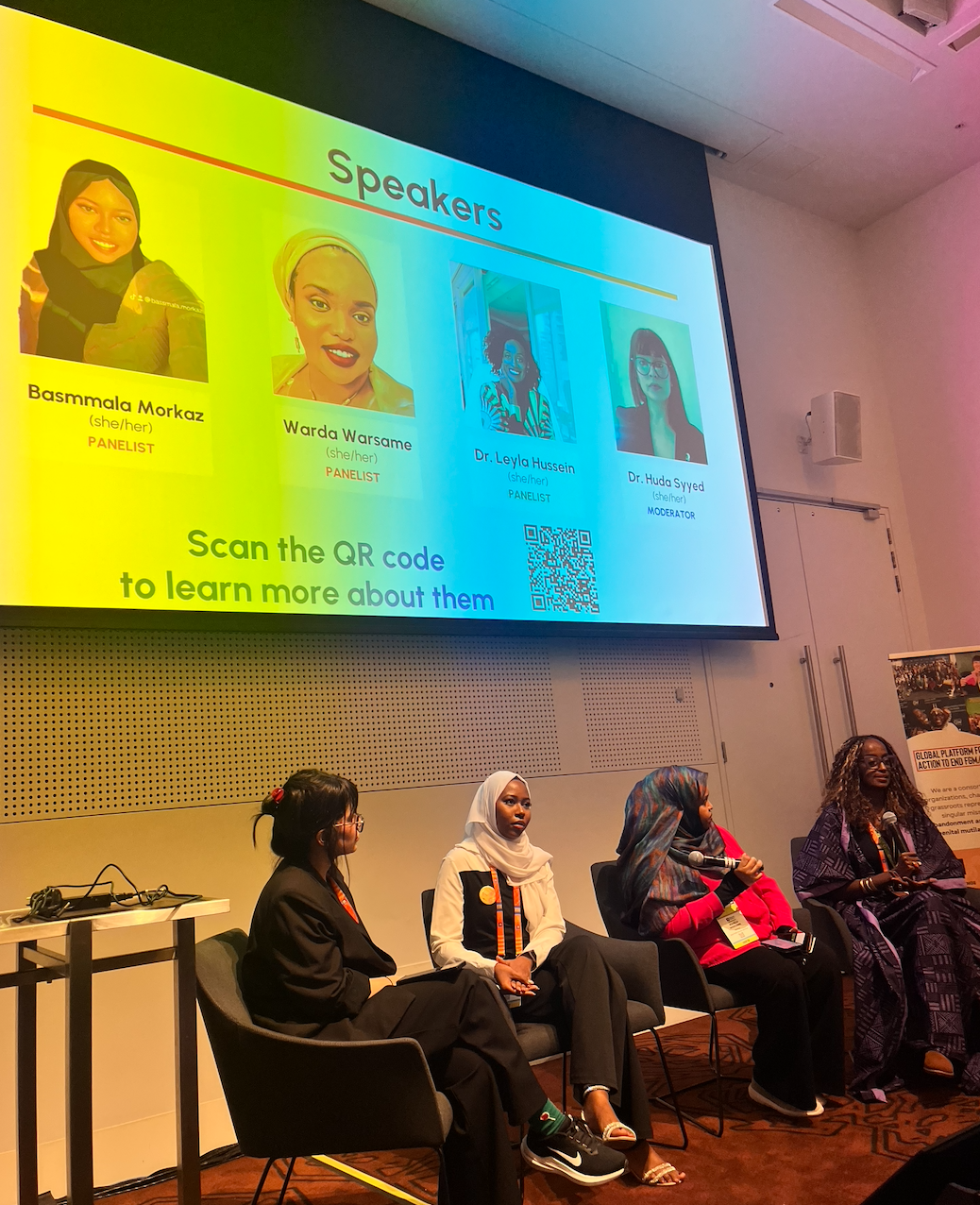
I had the privilege of moderating the concurrent session, which launched the position paper titled “Dismantling Racism in Anti-FGM/C Movements: Path to Decolonial, Survivor-Led Advocacy,” published by Sahiyo, The Girl Generation, and Healing Equity United. The concurrent session, itself, was co-hosted by Sahiyo, the Global Platform for Action to End FGM/C, and The Girl Generation. This position paper and the concurrent session brought together survivors, advocates, policymakers and researchers to critically reflect on how racism, anti-Blackness, colonial narratives and racial hierarchies continue to shape anti-FGM/C advocacy itself.
The distinguished speakers included Dr. Leyla Hussein (The Girl Generation), Bassmala Morkaz (End FGM European Network), and Warda Warsame (End FGM Canada Network). Together, we reflected on the persistence of saviour narratives within global advocacy spaces, where affected communities are too often framed only through suffering while their intellectual, political, and grassroots leadership remains overlooked. What emerged throughout the discussion was a reminder that survivor leadership should not be tokenistic; it cannot simply mean inviting survivors into spaces already structured by institutions, funders and external experts. Meaningful survivor-led work requires redistribution of power, resources, and decision-making authority. Without this, representation risks becoming tokenistic and exploitative rather than transformative.
Moving Beyond Tokenism and Making Space for Survivor Leadership Now
This powerful concurrent session challenged the harmful racialised narratives that continue to shape anti-FGM/C advocacy, especially deficit-based framings and white saviourism that frame affected communities as passive subjects rather than agents of change, experts, and leaders. The discussion also highlighted how funding, policy influence, and institutional power are too often directed toward individuals and organisations without lived experience, community connection, or contextual understanding. Moving forward, policy responses and advocacy efforts must do more than simply include survivors; they must actively prioritise survivor leadership, expertise and decision-making power.
Too often, global conversations around FGM/C reproduce racialised narratives that frame certain communities as needing to be “saved,” while overlooking the knowledge, leadership, and ongoing grassroots work of survivors who are already driving conversations, advocacy and legislative change within their own communities.
My Reflections As An Advocacy Intern at Sahiyo
My own research study (Syyed, 2024), has deeply shaped the way I think about gender, hierarchy, the extractive dynamics in research and socio-economic structures. It has been a non-linear, imperfect, but necessary journey for me to understand how semantics and locational contexts shape FGM/C, and how it is important to use caring and contextual approaches when working with this issue (Syyed, 2024, 2025). My journey of being a listener and learner (Syyed, 2025), was further strengthened as an advocacy intern at Sahiyo. Conversations at the concurrent session and during my time at Sahiyo have stayed with me because they helped me recognise that survivor leadership is the way forward in anti FGM/C movements. For me, these conversations are a reminder that meaningful solidarity requires more than simply making space for survivors. It also requires us to ask difficult questions about power: Who is leading advocacy spaces? Who receives funding? Whose expertise is recognised? And whose voices continue to be spoken over, extracted from or positioned only as testimonies rather than knowledge?
My ongoing research and advocacy work have long engaged with questions of positionality, representation, and sitting in discomfort with the power dynamic in one’s identity (Syyed, 2025), and power within global gender justice movements. My time as an advocacy intern at Sahiyo created further opportunities to engage in these conversations in collaborative and movement-based spaces. Together, let’s make space for survivor leadership and not take space.
Dismantling racism within anti-FGM/C movements is not a side conversation; it is the main conversation we should be having right now. It is central to building ethical, survivor-centred, and truly transformative advocacy that challenges racist power hierarchies and makes space for real social change.